Shadowsocks vs VLESS Reality: Is Shadowsocks Still Enough? (2026)
For a decade, Shadowsocks was the answer. It defined what “getting through” meant: a lean encrypted proxy, simple to run, light on the wire, and for years invisible enough. If you learned censorship circumvention before 2020, you probably learned it on Shadowsocks. VLESS Reality is what the same ecosystem builds today, and the difference is not incremental. Here’s the honest comparison.
The short answer
Shadowsocks still works on networks that aren’t really looking. Against equipment that is, its two old weaknesses (high-entropy traffic and probeable servers) have become the exact checks censors run first. VLESS Reality passes both, and your current apps almost certainly already speak it.
Head to head
Shadowsocks
VLESS Reality
Designed
2012, encrypted SOCKS-style proxy
2023, Xray ecosystem
What the network sees
A fully-encrypted, high-entropy stream on an odd port
A genuine TLS session with a real, well-known website
Entropy detection
Exposed: “unidentifiable encrypted traffic” is itself a signature
Passes: the handshake and traffic shape are real TLS
Active probing
Exposed historically: probed servers can be confirmed and blocklisted
Survives: a probe receives the real website back
Overhead
Minimal
Small camouflage cost
Client apps
Everything, including legacy apps
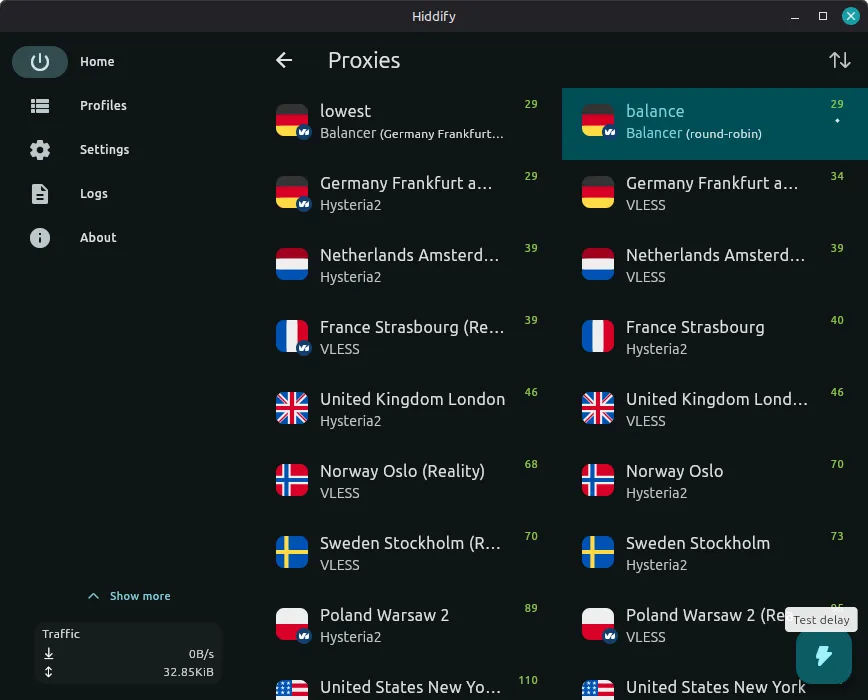
The modern generation: sing-box family, V2Box, Hiddify, Clash Meta
Track record under pressure
Purged in waves, especially around sensitive dates
Current default in the anti-censorship ecosystem
Why Shadowsocks started losing
Shadowsocks never pretended to be something else. It encrypted everything and hoped the result looked like nothing in particular. That worked until censors flipped the logic: traffic that looks like nothing in particular is itself suspicious. Equipment that flags fully-encrypted, high-entropy flows catches Shadowsocks without decrypting a byte, and it has been deployed aggressively since the early 2020s, with the dial turned up around sensitive dates.
The second weakness is older: a censor that suspects an address can simply connect to it and poke. Shadowsocks servers respond in ways that can be confirmed. Whole waves of servers have been identified and blocklisted this way, which is why the ecosystem’s own developers moved on.
Why VLESS Reality holds
Reality inverts the disguise. Instead of hiding as noise, it presents the genuine TLS handshake of a real website: real certificate presentation, real handshake shape, on TCP 443 like every HTTPS session on earth. SNI inspection sees a normal site. Fingerprinting sees a normal browser handshake. An active probe gets the real website back. There is no “unidentifiable traffic” to flag, because the traffic identifies as something ordinary and verifiable.
The client side of the ecosystem converged years ago: sing-box based apps (V2Box, Hiddify) and Clash Meta speak both protocols. If you use one of those for Shadowsocks today, switching to Reality is not a new toolchain, it’s a different subscription link.
Self-hosting made sense when Shadowsocks was invisible. Today it means one IP address that burns the moment it’s noticed, a disguise you maintain by hand, and you as the on-call admin during exactly the crackdowns when you need the connection most.
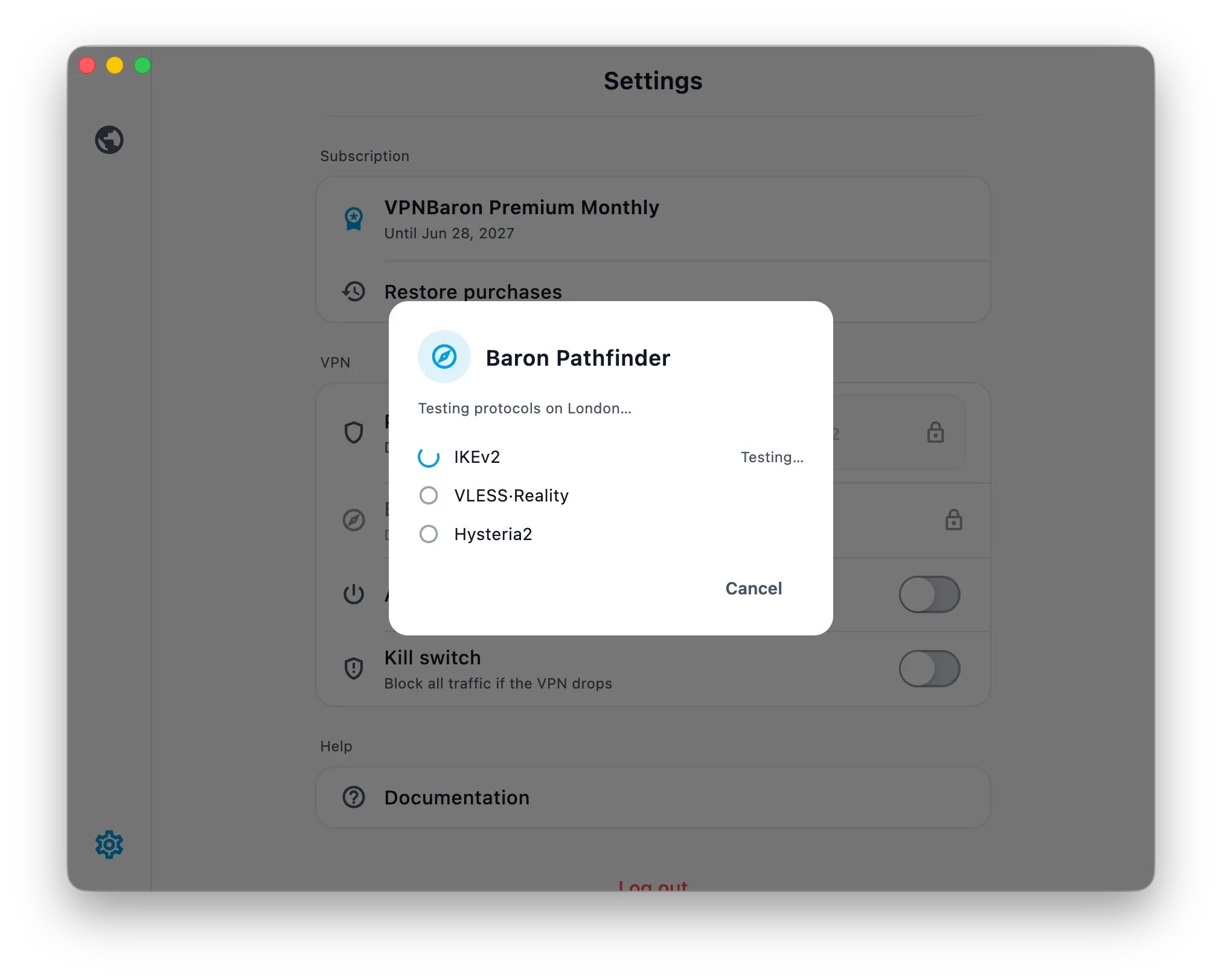
The app route replaces all of that with one decision. In the VPNBaron app, Baron Pathfinder tests routes on the network you’re standing on and picks what connects, falling back to Reality when the network fights:
Fresh server addresses ship to everyone the day they go live, so a blocklisted IP is our rotation problem, not your evening project.
FAQ
Is Shadowsocks still safe to use in 2026?
On lenient networks, yes. Against modern equipment it’s increasingly fragile: entropy-based flagging and active probing both hit it, and both are exactly what Reality was designed to survive.
Does Shadowsocks still work in China?
Intermittently. Plain Shadowsocks tends to get cut fast, especially around sensitive dates. Plugin setups last longer but share the same exposure.
Is VLESS Reality faster?
They’re close on clean networks; Reality pays a small camouflage cost, Shadowsocks is marginally leaner. The real question is which one still connects on a hostile network, and there Reality wins.
Do I need new apps to switch?
Usually not: V2Box, Hiddify and Clash Meta speak both. It’s a subscription swap, not a toolchain swap.
What about Shadowsocks with plugins (v2ray-plugin, obfs)?
They extend its life by dressing it as WebSocket or TLS. You’re maintaining by hand the disguise Reality ships natively, without fully solving active probing.